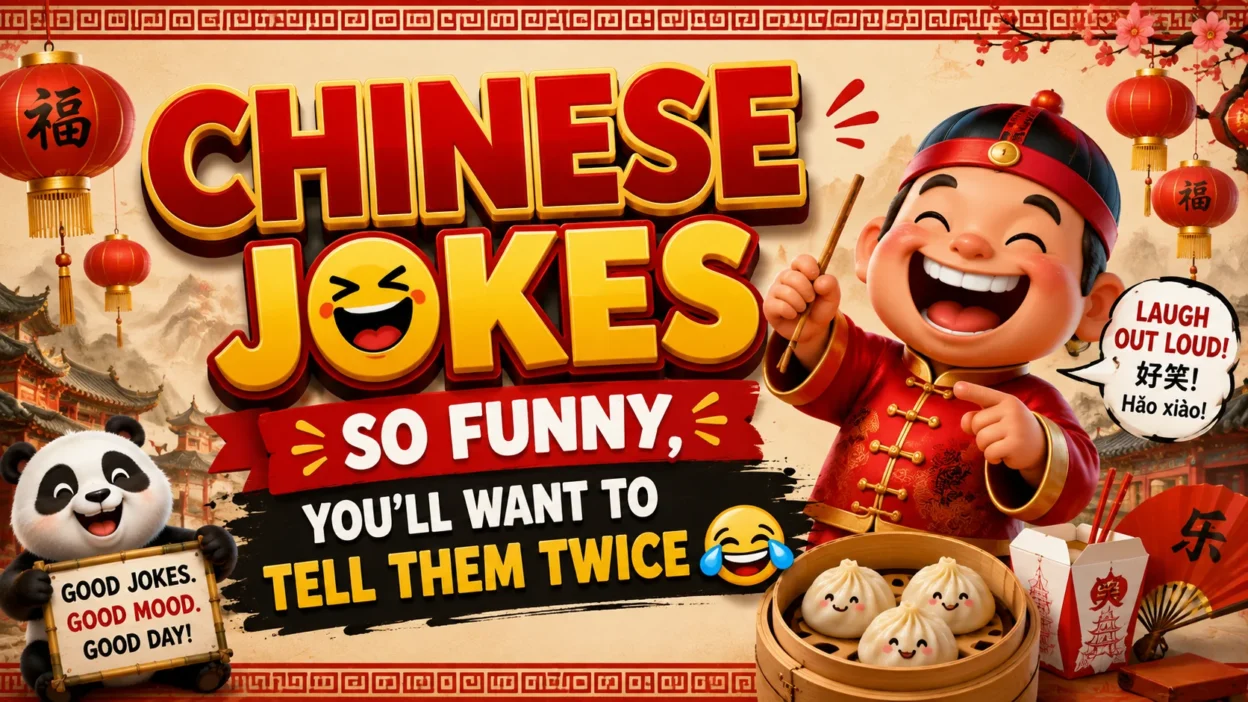
If you’re looking for Chinese jokes that are funny, clever, family-friendly, and easy to share, you’ve come to the right place. From Chinese food humor and Mandarin wordplay to chopstick jokes, dumpling puns, fortune cookie laughs, and lighthearted language-learning jokes, this collection has plenty of ways to make someone smile. 🥢😂
The best Chinese-themed jokes often come from familiar things such as noodles, rice, dumplings, tea, chopsticks, restaurants, Chinese characters, and learning Mandarin. These topics create plenty of opportunities for harmless puns and playful wordplay without making people or cultural identities the target of the joke.
Whether you’re looking for a funny caption, a classroom joke, something to share with friends, or a silly food-related one-liner, you’ll find plenty of ideas below.
So grab your chopsticks, order your favorite noodles, and get ready for a collection of jokes that are ready to wok your world. 🍜😄
Funny Chinese Jokes
Chinese-themed humor can be wonderfully playful when it focuses on food, language, learning, and everyday situations. These jokes are designed to be lighthearted and easy to understand.
- I told my chopsticks a joke, but they just stuck together. 🥢😂
- I tried learning Mandarin, but my tones kept changing the conversation.
- My favorite Chinese food is anything that comes with a second helping.
- I ordered noodles and accidentally ordered enough for the whole neighborhood.
- My fortune cookie predicted a great meal. Finally, a fortune I can trust.
- I asked my chopsticks to help with dinner, and they really picked things up.
- I tried eating noodles with chopsticks. The noodles had other plans.
- My Chinese takeout arrived faster than I could decide what to order.
- I don’t need a crystal ball when my fortune cookie is already doing the predicting.
- Dumplings are proof that good things really do come in small packages. 🥟
- I wanted to tell a food joke, but I didn’t want to stir things up.
- My noodles and I have a complicated relationship—we’re always tangled together.
- I opened the menu and immediately realized I had no idea what to choose.
- My chopstick skills are improving, but my dumplings remain undefeated.
- Chinese food is my favorite kind of comfort food—and my leftovers agree. 🍜
A good joke doesn’t have to be complicated. Sometimes a simple food pun or silly observation is all it takes to get a laugh.
Chinese Food Jokes
Chinese cuisine provides endless material for food lovers who enjoy a little wordplay. From fried rice to noodles and dumplings, these jokes are deliciously cheesy.
- I have a wok-solid relationship with Chinese food. 🍚
- I tried to quit takeout, but I couldn’t wok away.
- Fried rice is just rice that decided to live a little.
- Dumplings are tiny pockets of happiness.
- I like my noodles long and my dinner plans short.
- My diet ended the moment I smelled fried rice.
- Rice is nice, but fried rice knows how to party.
- I don’t always order Chinese food, but when I do, I order enough for tomorrow.
- Noodles are basically edible strings of happiness.
- My dumplings have better social lives than I do.
- Chinese food is proof that leftovers can have a second career.
- I asked for one more dumpling and accidentally started another meal.
- My favorite food group is anything served with chopsticks.
- Chinese takeout is my kind of long-term relationship.
- Life is better when your plate has noodles on it. 🍜❤️
Food-related humor is especially useful for social media captions, restaurant posts, and anyone who wants a quick joke that almost everyone can appreciate.
Chinese Food Puns
If you love clever wordplay, Chinese food gives you plenty of ingredients to work with. These short puns are ideal for captions, texts, and funny posts.
- Wok this way! 🥢
- Keep calm and wok on.
- I’m soy into this meal.
- Have a rice day! 🍚
- Let’s wok and roll.
- Don’t noodle around—it’s dinner time.
- You are soy amazing.
- Dumpling is my love language.
- I’m having a rice situation.
- Wok hard, eat harder.
- Life is better when you go with the noodle flow.
- This meal is absolutely wok-tastic.
- I can’t espresso how much I love noodles.
- Soy glad I ordered extra.
- I’m feeling a little saucy today. 😂
Short puns are great when you need something quick. They also work particularly well beneath food photos or as playful restaurant captions.
Mandarin Jokes
Mandarin Chinese is a tonal language, making pronunciation an interesting challenge for learners. That challenge can inspire plenty of good-natured classroom humor.
- Learning Mandarin is easy until the tones join the conversation.
- I practiced my Chinese pronunciation so much that my mouth asked for a vacation.
- My vocabulary is growing faster than my confidence.
- I know the word—I just don’t know which tone wants it.
- Mandarin taught me that one syllable can have a surprisingly busy life.
- My teacher asked me to repeat it, so I repeated it with even more confidence and the wrong tone.
- My Mandarin is fluent in my imagination.
- I learned five Chinese words today and immediately forgot two.
- Chinese tones are like tiny traffic signals for pronunciation.
- I thought I was speaking clearly until my teacher gave me that look.
- My Chinese dictionary understands me better than my pronunciation does.
- I’m not making pronunciation mistakes; I’m discovering creative alternatives.
- Every Mandarin lesson adds a new level to the challenge.
- My tones and vocabulary are still negotiating their relationship.
- One day I’ll speak Mandarin fluently; today I’m celebrating getting the tones right. 📚
Language-learning humor can make studying feel less intimidating, especially for beginners who are getting used to pronunciation and tones.
Chinese Language Learning Jokes
Learning a new language takes patience, practice, and plenty of repetition. These jokes are perfect for students, teachers, and anyone trying to build their Chinese vocabulary.
- My Chinese flashcards know more words than I do.
- I studied Chinese for three hours and learned that I need to study Chinese for three more.
- Every new Chinese character feels like unlocking a tiny puzzle.
- I remember the word perfectly until someone asks me to say it.
- My Chinese notebook is full of characters and questionable handwriting.
- I don’t forget vocabulary; I temporarily lose access to it.
- My Chinese homework and I have a complicated relationship.
- I learned a new phrase and immediately forgot the old one.
- Studying Mandarin is 50% vocabulary and 50% trying to remember the tones.
- My brain has officially requested a vocabulary update.
- Chinese practice is teaching me patience one character at a time.
- I wanted to learn Chinese quickly, but my brain suggested taking the scenic route.
- My dictionary is basically my study partner.
- Every Chinese character I remember feels like a tiny victory.
- Fluency may take time, but at least the learning journey comes with plenty of funny mistakes. 😄
The important thing about language-learning humor is laughing at the learning process rather than at the people or language itself.
Chinese Character Jokes
Chinese characters can look fascinating to language learners because their shapes, strokes, and meanings require practice. That makes them perfect for playful study jokes.
- Chinese characters are basically tiny puzzles with very serious faces.
- I don’t write Chinese characters; I negotiate with them.
- My handwriting has officially entered experimental art territory.
- Every character looks simple until I have to write it from memory.
- My pen knows the strokes better than my brain does.
- I learned one character yesterday, and today it looks like a stranger.
- Chinese characters have more personality than some people I know.
- My notebook contains beautiful characters and several accidental inventions.
- Writing characters is part language class and part geometry lesson.
- I tried memorizing characters by shape. My brain said, “Good luck.”
- Every stroke matters, which is why my handwriting needs supervision.
- I asked how to remember one character and somehow learned three more.
- My favorite character is whichever one I can remember without checking my notes.
- Chinese handwriting practice is where patience becomes a superpower.
- One character at a time, I’m slowly becoming less confused. ✍️😂
These jokes are especially suitable for students and teachers who want to make Chinese language practice a little more entertaining.
Chopstick Jokes
Chopsticks may look simple, but anyone who has tried using them knows they can turn dinner into an unexpected coordination challenge.
- My chopsticks and I are still working on communication. 🥢
- I tried eating noodles with chopsticks, and the noodles won.
- Chopsticks are two sticks and one very humbling experience.
- My chopstick technique is somewhere between beginner and comedy show.
- I finally caught a dumpling with chopsticks, and it felt like an Olympic victory.
- My rice has excellent escape skills.
- Chopsticks don’t judge your coordination—they simply reveal it.
- I picked up one noodle and accidentally brought half the bowl with it.
- My chopsticks have one important job, and somehow I still need practice.
- Two sticks can create either dinner or complete chaos.
- Chopsticks taught me that patience is an important ingredient.
- I don’t need a fork; I need chopstick confidence.
- My dumpling reached the plate, but it took three attempts.
- Chopstick practice should count as a workout.
- Dinner tastes better when you successfully grab the last dumpling. 🥟
Chopstick jokes are perfect for restaurant captions and funny stories about learning how to use them.
Dumpling Jokes
Dumplings are one of the most beloved foods associated with Chinese cuisine, and their small size and delicious fillings make them perfect subjects for playful jokes.
- Dumplings are little pockets of happiness. 🥟❤️
- You are dumpling special.
- Life is better with a basket of dumplings.
- I have a serious dumpling addiction, but I’m taking it one bite at a time.
- One dumpling is never enough.
- My love language is steamed dumplings.
- Dumplings are proof that good things come in small packages.
- I tried sharing my dumplings, but apparently I have boundaries.
- Dumpling is my favorite kind of therapy.
- I ordered enough dumplings to establish my own supply chain.
- My dumplings understand me because they are full of feelings.
- Don’t worry about my mood—just bring dumplings.
- A dumpling a day keeps the bad mood away.
- I find your dumpling personality very appealing.
- Nothing says happiness like a full basket of dumplings. 🥟😂
These jokes can also be turned into food captions for restaurant visits, homemade meals, and dumpling photography.
Noodle Jokes
Noodles are another perfect source of wordplay because they’re long, flexible, tangled, and incredibly popular.
- I’m totally tangled up in these noodles. 🍜
- Don’t noodle around—it’s dinner time.
- Noodles are my emotional support food.
- Life is better when you go with the noodle flow.
- I have a long-term relationship with noodles.
- My plans are flexible, just like noodles.
- I asked the noodles for directions, but they were too tangled.
- Noodles have mastered the art of going with the flow.
- My bowl is having a complicated noodle situation.
- I tried to eat one noodle, but it brought all its friends.
- Noodles are basically edible friendship bracelets.
- Keep calm and noodle on.
- My noodle strategy is simple: eat first, untangle later.
- A good noodle bowl can solve almost anything.
- I may not have everything figured out, but at least I have noodles. 🍜❤️
Noodle jokes work especially well for short captions because words like “noodle,” “tangle,” and “flow” naturally lend themselves to playful expressions.
Fortune Cookie Jokes
Fortune cookies are famous for their tiny predictions and mysterious messages. That makes them a natural source of funny one-liners.
- My fortune cookie predicted a great meal. It was absolutely correct. 🥠
- I opened a fortune cookie and got better advice than I expected.
- My fortune said I would receive a surprise. Then I saw the restaurant bill.
- Fortune cookies are tiny philosophers with a sweet tooth.
- I trust fortune cookies because they come with snacks.
- My fortune said, “Follow your dreams.” Mine led straight to dessert.
- I asked my fortune cookie for relationship advice. It told me to order another cookie.
- My fortune predicted success, so naturally I ordered dessert.
- The cookie knows my future, but apparently not my dinner order.
- I got a blank fortune, so apparently my future is still buffering.
- My fortune said good things were coming. I assumed it meant dumplings.
- Fortune cookies have excellent timing.
- I don’t need a crystal ball when I have takeout.
- My cookie told me to be adventurous, so I ordered something new.
- A little cookie, a little wisdom, and a lot of sugar—that’s a good deal. 😂
Fortune cookie humor is easy to personalize because almost any prediction can be turned into a funny situation.
Chinese Restaurant Jokes
Chinese restaurants provide plenty of relatable moments, from choosing dishes to opening fortune cookies and taking home enough leftovers for another meal.
- I opened the menu and immediately forgot how to make decisions.
- The hardest part of Chinese takeout is deciding what not to order.
- I went in for one dish and left with enough food for three people.
- My restaurant table had so many plates that we needed a seating chart.
- I said I would only order one thing. The menu laughed.
- Chinese takeout is my favorite kind of commitment.
- I came for noodles and stayed for everything else.
- The waiter asked if I wanted extra rice. Was that even a question?
- I ordered dinner and accidentally planned tomorrow’s lunch too.
- Restaurant math: one entrée somehow becomes several containers of leftovers.
- My favorite part of the meal is when the food starts arriving.
- I always promise myself I’ll try something new, then order my usual.
- The menu has too many delicious options and not enough stomach space.
- I went out for dinner and came home with tomorrow’s lunch.
- The best restaurant surprise is realizing you ordered enough for everyone. 😂
Restaurant jokes are ideal for social media posts, food blogs, and anyone who loves the experience of ordering Chinese takeout.
Chinese New Year Jokes
Chinese New Year, also known as Lunar New Year in broader contexts, is associated with family gatherings, celebrations, food, traditions, and festive wishes. These jokes keep the focus on cheerful celebration.
- My New Year’s resolution is to eat more dumplings. 🥟
- New year, same appetite.
- I came for the celebration and stayed for the food.
- May your year be lucky, prosperous, and full of delicious snacks.
- My favorite New Year’s tradition is the one involving a full plate.
- New year, new goals, same love for noodles.
- I don’t need a fortune cookie to predict that I’ll eat too much.
- May your celebrations be bright and your leftovers plentiful.
- Starting the year with a full plate and a happy heart.
- Good fortune is wonderful, but have you tried dumplings?
- My resolution is simple: more happiness, more family time, more food.
- May your year be as satisfying as a perfect bowl of noodles.
- Fresh year, fresh luck, extra rice.
- Here’s to prosperity, laughter, and no empty snack bowls.
- Wishing you a celebration full of smiles, good food, and great memories. 🧧❤️
Festive humor works best when it celebrates the occasion and the joy of spending time with family and friends.
Chinese Dad Jokes
Dad jokes are intentionally simple and predictable, which makes them perfect for food and language-themed wordplay.
- Why did the noodle get promoted? It had great connections.
- Why did the dumpling blush? It saw the sauce. 🥟
- Why did the rice go to school? To become more cultured.
- What does a happy chopstick say? “Stick with me!”
- Why did the wok get invited to the party? It knew how to stir things up.
- Why was the noodle relaxed? It knew how to go with the flow.
- Why did the dumpling stay home? It needed some filling time.
- Why did the rice tell a joke? It wanted to stir up some laughter.
- Why did the fortune cookie become a comedian? It had good timing.
- Why did the chopsticks break up? They couldn’t handle the separation.
- Why did the bowl feel important? It held everything together.
- Why did the noodle get confused? It was all tangled up.
- Why did the wok win a prize? It was outstanding in the kitchen.
- Why did the dumpling smile? It was having a filling day.
- Why did the rice become famous? It knew how to make a grain entrance. 😂
The beauty of dad jokes is their simplicity. They’re meant to earn an eye roll and a smile at the same time.
Chinese Jokes for Kids
Kid-friendly humor works best when the jokes are simple, silly, and easy to understand. These food and language jokes are suitable for family conversations and classrooms.
- What do chopsticks say when they agree? “We stick together!” 🥢
- Why did the noodle smile? It was having a good day.
- Why did the dumpling go to school? To get a better filling.
- Why did the wok laugh? Someone stirred up a funny joke.
- Why did the fortune cookie go to school? To learn about its future.
- Why was the noodle happy? It was going with the flow.
- Why did the dumpling cross the table? To get to the sauce.
- Why did the chopsticks get a job? They were good at picking things up.
- Why did the rice join the party? It didn’t want to miss the fun.
- What do noodles say when they need help? “I’m tangled!”
- Why did the bowl smile? It was feeling full of joy.
- What is a dumpling’s favorite subject? Filling in the blanks.
- Why did the cookie tell jokes? It had a fortune in comedy.
- What did the chopstick say to the noodle? “I’ve got you!”
- Why did the rice bring a friend? It didn’t want to be left out. 😂
These jokes can be useful for parents, teachers, and anyone looking for wholesome humor related to food and language.
Chinese Jokes for Students
Students learning Chinese often deal with vocabulary, pronunciation, characters, homework, and lots of repetition. That makes the learning process perfect for relatable humor.
- My Chinese vocabulary is growing, but my memory didn’t get the memo.
- I studied Chinese all evening and rewarded myself with noodles.
- My homework says “practice,” while my brain says “snack.”
- I know the answer until the teacher looks directly at me.
- My Chinese flashcards have become my closest study companions.
- I can recognize the character but writing it is another adventure.
- Mandarin practice is teaching me patience one tone at a time.
- My pronunciation is improving slowly but surely.
- I learned a new phrase and immediately wanted to celebrate with dumplings.
- My notebook has more Chinese characters than my phone has notifications.
- Studying Chinese is a workout for both memory and handwriting.
- I don’t need another study break; I need another vocabulary miracle.
- My brain has room for more Chinese words after a snack.
- Every correctly remembered character deserves a tiny celebration.
- I’m not struggling with Chinese; I’m building character. 😄📚
Student humor is especially useful for classroom bulletin boards, language-learning social posts, and study groups.
Chinese Jokes for Instagram
If you need something short for a food photo, travel picture, restaurant visit, or language-learning post, these captions are easy to use.
- Wok this way. 🥢
- Keep calm and wok on.
- Just here for the dumplings.
- Having a rice day. 🍚
- Noodle-ing my way through life.
- Soy into this meal.
- Dumpling is my love language.
- Chopstick skills: still loading.
- Feeling wok-tastic.
- Good food, good mood, great noodles.
- Life is better with a little soy sauce.
- Currently in my noodle era.
- Serving looks and dumplings.
- Powered by noodles and good vibes.
- My camera roll is mostly food, and I’m not apologizing. 😂
A short caption can make a food or travel photo more memorable without taking attention away from the image itself.
Chinese Travel Jokes
Traveling to China or exploring Chinese food and culture can create funny situations involving language, food, directions, packing, and new experiences.
- I traveled for the culture but stayed for the noodles. ✈️🍜
- My suitcase had clothes; my heart had dumplings.
- I learned three Chinese words before my trip and used all three confidently.
- My travel itinerary had one important stop: food.
- I asked for directions and somehow ended up near a restaurant.
- Travel tip: always know where the nearest noodle shop is.
- I packed light so I could bring home snacks.
- The best souvenir is a great meal memory.
- I don’t need a map when I can follow the smell of dumplings.
- Traveling teaches you many things, especially how much food you can eat.
- My passport gets stamped; my stomach gets happy.
- I came for the sights and discovered a new favorite dish.
- Every trip needs good company and better food.
- My vacation budget was mostly snacks.
- I may forget some landmarks, but I’ll remember the dinner. 😂
Travel humor works best when it celebrates the experience of discovering new foods, places, and memories.
Chinese Puns for Social Media
Whether you’re posting about food, language learning, travel, or a funny moment, these short puns can add personality to your social content.
- Wok-ing on my best life. 🥢
- Rice and shine!
- Noodle around and find out.
- Soy happy right now.
- Dumpling days are the best days.
- Feeling a little extra saucy.
- Wok hard, relax harder.
- Life is better with good food.
- Stay calm and grab the chopsticks.
- My mood is currently 90% noodles.
- Just a little soy much fun.
- Good vibes served family-style.
- Making memories one meal at a time.
- Happiness comes in a dumpling basket.
- This post has been officially wok-approved. 😂
These work particularly well when you want a playful caption without writing a long description.
Clever Chinese Jokes
Clever humor often relies on wordplay and unexpected connections. These examples combine food, language, and everyday observations.
- I wanted to become fluent in Chinese, but my vocabulary asked for a few more lessons.
- My chopsticks have excellent teamwork skills.
- Noodles never panic because they know how to go with the flow.
- Dumplings are great at keeping things contained.
- Rice is incredibly adaptable—it always finds a way onto the menu.
- My fortune cookie is optimistic, but my restaurant bill is realistic.
- Chinese characters taught me that small details can make a big difference.
- My language skills are developing one memorable phrase at a time.
- Chopsticks prove that teamwork sometimes comes in pairs.
- A noodle’s greatest strength is flexibility.
- Dumplings are basically edible packages of happiness.
- A fortune cookie is the only dessert that gives career advice.
- My Chinese homework is building both vocabulary and character.
- Learning Mandarin is a tone-by-tone adventure.
- The best food jokes are always well-seasoned. 🥢😂
Clever jokes don’t need to be complicated. A simple double meaning can often make a punchline much more memorable.
Chinese Food One-Liners
Sometimes you need a joke that is short enough to deliver instantly. These one-liners are ideal for texts, captions, comments, and casual conversations.
- I’m soy into Chinese food.
- Wok hard, eat harder.
- Noodles are my kind of therapy.
- Dumplings make everything better.
- Rice is always a good idea.
- I came, I saw, I ordered takeout.
- Keep your friends close and your chopsticks closer.
- My love for noodles has no limits.
- I’m on a strict dumpling diet.
- Wok now, think later.
- A day without noodles is a missed opportunity.
- My fortune cookie knows too much.
- I have a very filling social life.
- Chopsticks: because two sticks are better than one fork.
- Chinese food is always a good idea. 🍜❤️
One-liners are especially useful when you need something quick and easy to remember.
Best Chinese Jokes
After all the food puns, language jokes, and silly one-liners, here are some favorites that combine cleverness with simple humor.
- My chopsticks and I have a strong relationship—we always stick together. 🥢❤️
- I tried to quit Chinese takeout, but I couldn’t wok away.
- My fortune cookie told me great things were coming. Then my dumplings arrived.
- Learning Mandarin is easy until you realize every tone has a job.
- Dumplings are just tiny edible hugs.
- I asked my noodles for advice, but they were too tangled to answer.
- My Chinese homework is helping me build character—literally.
- I don’t need a crystal ball; my fortune cookie already has plans for me.
- My chopstick skills are improving, one dropped dumpling at a time.
- Fried rice is just rice that decided to become more exciting.
- Life is better when you go with the noodle flow.
- I ordered enough Chinese food to make tomorrow jealous.
- My vocabulary may be small, but my appetite is fluent.
- The best kind of fortune is one that comes with dessert.
- If happiness had a flavor, it would probably taste like dumplings. 🥟😂
The best jokes are usually the ones you can remember and retell easily, which is why short food puns and relatable language jokes work so well.
FAQs About Chinese Jokes
What are Chinese jokes?
Chinese jokes can refer to jokes involving Chinese food, Mandarin language learning, Chinese characters, chopsticks, dumplings, noodles, restaurants, festivals, or other everyday themes. The most respectful versions use playful wordplay rather than making people or cultural identities the punchline.
What are some funny Chinese food jokes?
Some popular food jokes include “I have a wok-solid relationship with Chinese food,” “I tried to quit takeout, but I couldn’t wok away,” and “Dumplings are little pockets of happiness.” Food-related wordplay is easy to understand and works well for captions.
What are some funny Mandarin jokes?
Mandarin jokes often play with tones, pronunciation, vocabulary, and the experience of learning a tonal language. For example, a student might joke that their vocabulary is improving while their tones are still “negotiating” with each other.
Are Chinese food puns good for Instagram captions?
Yes. Short phrases such as “Wok this way,” “Keep calm and wok on,” “Rice and shine,” and “Noodle-ing my way through life” work well as captions for food pictures, restaurant visits, and travel posts.
What are some funny chopstick jokes?
A simple chopstick joke is, “My chopsticks and I have a great relationship—we always stick together.” Another is, “Chopsticks are two sticks and one very humbling experience.”
What are some Chinese jokes for kids?
Kid-friendly examples include jokes about noodles, dumplings, rice, chopsticks, and fortune cookies. For example: “What do chopsticks say when they agree? We stick together!” These jokes are simple and easy for children to understand.
Can Chinese jokes be used for language-learning classes?
Yes. Jokes about Chinese vocabulary, pronunciation, tones, characters, and study habits can make lessons more engaging. Teachers can also use food-related puns as lighthearted examples during vocabulary activities.
What makes a good Chinese-themed joke?
A good joke should have a clear punchline and be easy to understand. Food wordplay, language-learning humor, and everyday situations are usually safer and more relatable than jokes that rely on stereotypes.
Are Chinese New Year jokes appropriate for social media?
Yes, when they are respectful and focused on celebration, family gatherings, food, good wishes, and festive traditions. Humor should celebrate the occasion rather than mock cultural practices.
What are some short Chinese puns?
Examples include “Wok this way,” “Rice and shine,” “Keep calm and wok on,” “Soy into this,” and “Don’t noodle around.” These are especially useful for captions and quick messages.
Conclusion
These Chinese jokes bring together food puns, Mandarin humor, chopstick jokes, dumpling wordplay, noodle one-liners, fortune cookie jokes, language-learning humor, and family-friendly laughs. 🥢😂
Whether you’re looking for a funny Chinese food caption, a classroom joke, a playful social media line, or something silly to send to a friend, there are plenty of options to choose from. The best part is that these jokes focus on relatable experiences such as eating noodles, learning vocabulary, trying chopsticks, opening fortune cookies, and enjoying a great meal.
Use your favorites for captions, texts, classroom activities, restaurant posts, or simply to make someone laugh. And remember: when it comes to Chinese food humor, there’s always room for one more dumpling and one more joke. 🥟❤️

Jason Blake is a humor writer and content creator behind PickUpPunch, passionate about crafting funny pickup lines, witty puns, clever captions, and viral jokes that keep readers entertained. With a love for wordplay and modern internet humor, Jason creates content designed to spark laughs, start conversations, and make every scroll more fun. ✨